Yes, a landlord can legally keep some or all of a tenancy deposit in certain circumstances, but they cannot simply keep your money because you have moved out.
In England, a landlord may be able to make reasonable deductions for things such as unpaid rent, damage beyond normal wear and tear, or other genuine losses connected with the tenancy. If you believe a deduction is unfair, excessive or unsupported, you can question it.
The tenancy deposit rules protect your deposit, and you resolve any dispute over a protected deposit while the protection stays in place.
When can a landlord legally keep your deposit?
A landlord may have a legitimate reason to deduct money from your deposit if you have caused a financial loss that you are responsible for under the tenancy.
Common examples include:
- unpaid rent
- damage caused by the tenant
- missing items
- The landlord carried out excessive cleaning after the property was left in a substantially worse condition.
- other costs resulting from a breach of the tenancy agreement
However, the fact that your landlord claims money from your deposit does not automatically mean the deduction is justified.
The circumstances and evidence matter.
Can a landlord keep your entire deposit?
A landlord may potentially claim the whole deposit if their legitimate losses are equal to or greater than the amount of the deposit.
But a landlord cannot simply decide to keep the entire deposit without a proper basis.
For example, if a landlord claims £1,500 for damage but the evidence supports only a much smaller loss, you can question the landlord’s claimed amount.
Likewise, if the claimed damage was already present before you moved in, you may have grounds to challenge the deduction.
What can a landlord deduct from a deposit?
The most common deposit deductions relate to:
Unpaid rent
If you have genuinely left rent unpaid, your landlord may be able to seek payment from the deposit.
However, if you believe the landlord has incorrectly calculated your rent arrears, check your tenancy agreement and payment records.
Bank statements, rent receipts and messages can help establish what you actually paid.
Damage
A landlord can potentially claim for damage that you caused beyond ordinary wear and tear.
The important distinction is between damage and normal deterioration.
For example, accidentally breaking a fixture may be different from an old fixture becoming worn through normal use.
Cleaning
A landlord may seek a reasonable cleaning cost where you have left the property in a substantially worse condition than it was in at the beginning of the tenancy.
But you should compare the property’s condition at the beginning and end of the tenancy.
If the previous cleaners did a poor cleaning job before you moved in, it may affect a later cleaning claim.
Missing items
A landlord may be able to claim for items that were provided as part of the tenancy but are missing when you leave.
Your inventory can be particularly important here.
Record what you noted at the start of the tenancy and what you noted as present when you moved out.
What can a landlord NOT simply charge you for?
A landlord cannot simply use your deposit as a general source of money.
You should question deductions where:
- the landlord has not explained what the charge is for
- the alleged damage existed before you moved in
- the issue is normal wear and tear
- the amount appears excessive
- there is little evidence supporting the claim
- the landlord appears to be charging you for an improvement
- you have already paid for the repair
- You left the property in a condition similar to when you moved in.
The deposit protects the landlord against legitimate losses. The deposit should not be used to finance improvements at the tenant’s expense.
What is normal wear and tear?
Normal wear and tear is the ordinary deterioration that occurs through reasonable use of a property over time.
For example:
- carpets becoming worn
- paint becoming less fresh
- minor marks from ordinary use
- fixtures becoming older
- ordinary deterioration of furniture or appliances
The longer you have lived in a property, the more relevant normal ageing can become.
When considering a deduction, look at:
- how long the tenancy lasted
- the age of the item
- its condition when you moved in
- its expected lifespan
- how it was used
- its condition when you left
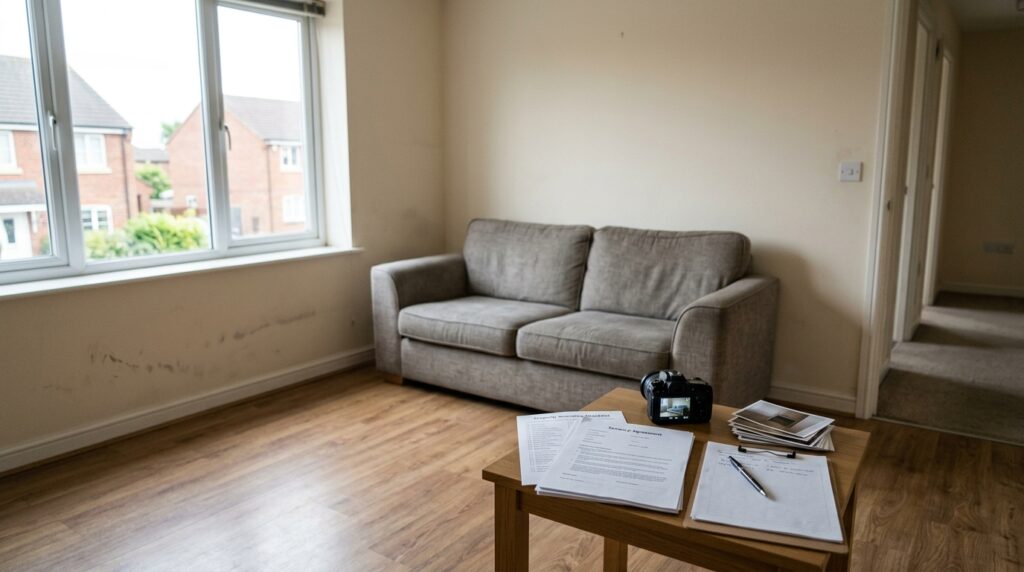
Can a landlord charge you for a brand-new replacement?
Not necessarily.
If the landlord damages an old item, they should not claim the full replacement cost for a brand-new equivalent.
The age and previous condition of the item can be relevant when considering the landlord’s actual loss.
If the previous occupant wore the carpet heavily before you moved in, you should question the full-cost carpet claim.
Some describe it as avoiding betterment, and the landlord should not end up better off due to the tenant’s deposit.
How does the landlord decide how much to deduct?
There is no universal percentage that a landlord can automatically deduct for damage.
The amount will depend on the circumstances.
Consider:
What was the condition before the tenancy?
Look at your check-in inventory and photographs.
What is the condition now?
Compare the check-in and check-out evidence.
What actually happened?
Did you cause the problem, or did it arise from ordinary use or an existing defect?
What is the landlord’s actual loss?
Review the amount claimed and whether the landlord has supporting evidence.
How old is the item?
We cannot treat an old item as if it were brand new when the tenancy started.
What evidence should you keep?
If there is a possibility of a deposit deduction, keep your tenancy records.
Useful evidence includes:
- tenancy agreement
- check-in inventory
- check-out report
- photographs
- videos
- emails
- text messages
- WhatsApp messages
- repair requests
- maintenance records
- receipts
- invoices
- rent payment records
Your evidence can be particularly important if you later need to challenge the amount someone is claiming.
Take photographs before leaving
If you have not yet moved out, take clear photographs and videos of the property.
Photograph:
- every room
- floors and carpets
- walls and ceilings
- kitchen
- bathroom
- appliances
- furniture
- garden or outside areas
- any existing damage
Keep the original files where possible.
Does the landlord have to protect my deposit?
For qualifying private tenancies in England, the landlord must protect the deposit in a government-approved tenancy deposit protection scheme.
The approved schemes are:
- Deposit Protection Service (DPS)
- MyDeposits
- Tenancy Deposit Scheme (TDS)
The current GOV.UK guidance states that the deposit must be protected within the required period and that the landlord must provide tenants with information about how the deposit is protected and how disputes can be dealt with.
If your landlord has not protected your deposit when they were required to do so, that is a separate issue from simply disagreeing with a deduction.
How long can a landlord keep your deposit?
We should distinguish between the landlord holding the deposit while we agree the amount and the landlord simply refusing to return it.
For a protected deposit, the landlord must return the agreed amount within 10 days of the landlord and tenant agreeing how much the tenant should receive back.
The 10 days does not simply mean 10 days after you hand back the keys in every case.
If there is an unresolved dispute, you keep the deposit protected while you deal with the issue.
For more detail, see:
How Long Does a Landlord Have to Return a Deposit in England?
What if my landlord says I damaged the property?
Do not automatically accept the deduction.
First, look at the evidence.
Ask yourself:
- Was the damage already there?
- What did the check-in inventory say?
- Do I have photographs from when I moved in?
- Is this actually normal wear and tear?
- Did I report the problem during the tenancy?
- Does the landlord have evidence showing that I caused it?
- Is the amount being claimed reasonable?
- Is the landlord claiming the cost of a brand-new replacement?
If the evidence does not support the deduction, you may have grounds to challenge it.
What if the landlord wants to keep money for cleaning?
Cleaning claims should also be looked at carefully.
The relevant issue is not whether the property is absolutely spotless when you leave.
The comparison is generally between the property’s condition at the start and end of the tenancy.
If the property was professionally cleaned before you moved in and you left it substantially dirtier, a reasonable cleaning claim may be possible.
But if it was already in a poor condition when you moved in and you left it in a similar condition, you may have grounds to question the deduction.
What if my landlord wants to keep my deposit for rent arrears?
Rent arrears can be a legitimate reason for a landlord to seek money from a deposit.
However, make sure the figures are correct.
Check:
- the rent stated in your tenancy agreement
- the dates payments were due
- your bank statements
- rent receipts
- payment confirmations
- any agreed rent changes
- correspondence about missed payments
If the landlord’s calculation is wrong, keep evidence showing the payments you made.
What if the landlord has not explained the deduction?
Ask for an explanation.
You should know:
- what the deduction relates to
- how much is being claimed
- why you are considered responsible
- what evidence supports the claim
- how the amount has been calculated
Do not feel that you have to accept a deduction simply because your landlord has listed it on a deposit statement.
Can I challenge an unfair deposit deduction?
Yes.
If you believe the landlord is claiming too much, charging for normal wear and tear, relying on damage that existed before your tenancy or failing to provide adequate evidence, you can question the deduction.
If your deposit is protected, your scheme may provide a dispute resolution service for disagreements over the deposit.
The government-approved schemes have processes for dealing with deposit disputes, and the deposit remains protected while an unresolved dispute is being dealt with.
But challenging a deduction can involve more than simply saying:
“I don’t agree.”
You need to identify the problem with the deduction and support your position with the evidence you have.
Need help challenging your landlord?
If your landlord is trying to keep money from your deposit and you are unsure what to say or do next, Renters Rights Act Services membership can give you practical help with the situation.
Members can access practical tenant resources, which can include:
- Deposit return letters
- Letters challenging unfair deductions
- Guidance on what evidence to gather
- Practical guidance on communicating with your landlord
- Support with understanding your next steps
- Situation Review support where included in your membership
You do not have to work out the wording of your deposit letter yourself.
Get practical deposit support
If your landlord is withholding money from your deposit, the next step is to understand why they are keeping it and whether the deduction can be justified.
If you need practical help dealing with the issue, join Renters Rights Act Services and access member resources designed to help tenants take the next step.
Join Now →
What if your landlord did not protect your deposit?
If your landlord was required to protect your deposit but failed to do so, this can create separate legal rights.
GOV.UK states that a tenant can apply to the county court where a landlord should have used a tenancy deposit protection scheme but did not. A court may order repayment or payment into a custodial scheme and can potentially order compensation of up to three times the original deposit in qualifying circumstances.
This is different from an ordinary disagreement about whether a £200 cleaning deduction is fair.
If you think your deposit was never protected, keep evidence of:
- the amount you paid
- when you paid it
- who received it
- your tenancy agreement
- communications with your landlord or agent
You may need specific guidance about your circumstances.
What happens if you agree with the deduction?
If you agree with the amount being deducted, the remaining deposit should be returned according to the applicable deposit protection rules.
For protected deposits, GOV.UK states that the agreed amount must be returned within 10 days of both parties agreeing how much should be returned.
If you do not agree, do not simply assume the landlord is entitled to keep the money.
Check your evidence and the process available through your deposit protection scheme.
Quick deposit deduction checklist
Before accepting a landlord’s deduction, check:
- What exactly is the landlord claiming?
- Was the problem already present?
- What does my check-in inventory say?
- Do I have photographs from the beginning of the tenancy?
- Is this normal wear and tear?
- Has the landlord explained the amount?
- Is there evidence supporting the claim?
- Is the amount reasonable?
- Is my deposit protected?
- Have I asked the landlord for clarification?
- Do I need practical help responding?
If several answers raise concerns, do not simply accept the deduction without looking into it.
Frequently Asked Questions
Can a landlord legally keep my deposit?
Yes, a landlord can legally make reasonable deductions for legitimate losses such as unpaid rent or tenant-caused damage. However, they cannot simply keep the deposit without a proper basis for doing so.
Can a landlord keep my deposit for cleaning?
A landlord may be able to claim a reasonable cleaning cost if the property was left in a significantly worse condition than at the start of the tenancy. You can question the deduction if the property was left in a comparable condition or the amount appears unreasonable.
Can a landlord keep my deposit for normal wear and tear?
Normal wear and tear is ordinary deterioration caused by reasonable use over time. It should not automatically be treated as tenant damage.
Can my landlord keep my deposit if something was already damaged?
If the damage was already present when you moved in, you may have grounds to challenge a deduction for it. Your check-in inventory, photographs and other evidence can be important.
Can a landlord take the full deposit?
A landlord may potentially claim the full deposit where their legitimate losses justify that amount. However, the landlord should have a proper basis for the claim, and you can question deductions that appear unsupported or excessive.
What should I do if my landlord is keeping my deposit unfairly?
Check the reason for the deduction, compare it with your inventory and evidence, and ask the landlord or agent to explain the claim. If you need practical help with your response, Renters Rights Act Services membership provides deposit-related resources and support.
What to Read Next
- What to Do If Your Landlord Will Not Return Your Deposit — your main guide to dealing with a landlord who has not returned your deposit.
- How Long Does a Landlord Have to Return a Deposit in England? — understand the current deposit return deadline.
- How to Challenge Unfair Deposit Deductions — learn what to check when you believe a specific deduction is unfair.
- What Happens If Your Landlord Did Not Protect Your Deposit? — understand the separate rules that may apply when your deposit was not protected.
Legal information: This guide applies to tenants in England and provides general information, not legal advice. The rules and appropriate action can depend on your tenancy type and individual circumstances.
Last reviewed: September 2026