How it Works

Landlord Not Returning Deposit? Claim 1–3x Back

If your landlord not returning deposit, you have strong legal rights in England. Under the Housing Act 2004, your deposit must be protected in a government-approved scheme within 30 days, and returned within 10 days once you both agree the amount.

The single most important action right now is to check whether your deposit was protected and, if not, prepare a county court claim for the deposit back plus 1–3× compensation. This guide walks you through every step, from the 10-day rule to small-claims court, with templates and exact wording you can use.

Last reviewed: 2 days ago England only ~18 min read Checked against GOV.UK & Shelter

The Dangerous Mistake You Must Not Make

🚨 Do not withhold rent. In England there is no general right to withhold rent, even if your landlord has breached deposit rules or repair duties. It puts you at risk of arrears and weakens your position in court.
🚨 Do not move out on a notice alone. Since the Renters’ Rights Act came into force on 1 May 2026, Section 21 “no-fault” evictions are abolished. Possession is only available via Section 8 grounds with a court order.

🚨 Do not assume the eviction is lawful. If your deposit was never protected, that can block a possession claim until the landlord protects or repays it. Follow the correct process set out below.

See our full guide: Landlord Sent an Eviction Notice? Check It in 6 Steps
The Law

The Legal Foundation: Housing Act 2004, ss.213–215

Your deposit rights come from three sections of one Act. Here they are in plain English.

213

Protection and prescribed information

Your landlord must place your deposit in a government-approved tenancy deposit protection scheme within 30 days of receiving it, and give you prescribed information about the scheme in the same 30-day window.

214

Your compensation claim

If they fail to protect it or serve prescribed information, you can apply to the county court using Form N208. The court must order the landlord to repay the deposit and pay you compensation of 1–3x the deposit amount.

215

The possession bar

Until the landlord complies, they cannot serve a valid Section 8 notice. Post-RRA, an unprotected deposit blocks a possession claim until the breach is cured.

There are three approved schemes in England: Tenancy Deposit Scheme (TDS), Deposit Protection Service (DPS) and MyDeposits. Each offers free dispute resolution.
What Changed

How Unprotected Deposits Now Stop Eviction

Old rules

Before 1 May 2026

  • Section 21: landlord could evict without giving a reason.
  • Unprotected deposit: blocked Section 21 only, the landlord could still use Section 8.
Current rules

After 1 May 2026

  • Section 21 abolished: no more no-fault evictions. All tenancies are Assured Periodic Tenancies, so possession requires Section 8 grounds plus a court order.
  • Unprotected deposit is now a general compliance bar: courts can dismiss or stay any possession claim until the landlord protects or repays the deposit.

What this means for you

1. Do not leave on a notice alone, you may have a strong defence.
2. Counterclaim for 1–3x compensation in the same possession proceedings.
3. Ask the court to dismiss or stay the claim until the deposit breach is cured.

Deadlines

The 10-Day Rule: When Must a Landlord Return Your Deposit?

Answer: once you and the landlord both agree how much should be returned, the landlord must repay it within 10 days. This does not mean 10 days from your move-out date.

1

You move out and return the keys

Take final photos and meter readings on the same day.

2

The landlord inspects and proposes deductions

They should give you an itemised breakdown with evidence.

3

You review and either agree or dispute

Disputing does not forfeit anything. Put your response in writing.

4

Once both parties agree, the 10-day clock starts

If the landlord never responds or refuses to repay an agreed amount, that is a breach.

Next step: a formal letter before action, then a county court claim.

Deductions

What Your Landlord Can and Cannot Take

Deductions must reflect actual loss, not improvement.
Valid Deductions allowed, if the landlord proves actual loss
01
Unpaid rent — arrears at the end of the tenancy
Evidencearrears statement
02
Damage beyond fair wear and tear — large burns, broken windows, pet damage beyond normal wear
Evidencecheck-in vs check-out
03
Missing items listed in the inventory — keys, appliances
Evidencesigned inventory
04
Breach of tenancy terms that caused financial loss, such as unauthorised subletting costs
Evidenceproof of loss
05
Professional cleaning — only if the agreement required it and the property was left dirtier than at check-in
Evidenceboth conditions
Invalid Deductions challenge these — they are not allowed
✕
Betterment — charging “new for old” without accounting for age and wear
Citeapportionment
✕
Cleaning where the property was left as clean as at check-in
Citecheck-in report
✕
Gardening, unless you were contractually responsible and left it worse than at check-in
Citetenancy terms
✕
Administrative fees for “time spent” or “inspection fees”
Citeno actual loss
✕
Repairs for fair wear and tear — faded paint, minor scuffs, carpets worn by normal use
Citefair wear and tear
Key principle: your landlord cannot charge you to make the property better than when you moved in.

Betterment & Apportionment: Worked Examples

Tenant share = (age at start ÷ expected life) × replacement cost.

Your fair share, worked out what a landlord can legitimately claim
Carpet
£1,000 original cost · 3 years old at tenancy start · 10-year expected life
£30030% share
Sofa
£800 original cost · 5 years old at tenancy start · 8-year expected life
£50062.5% share
Paint
£400 to repaint living room · 2 years old at tenancy start · 5-year expected life
£16040% share
Hidden Breach

Prescribed Information: The Breach Most Tenants Miss

Under s.213(5) Housing Act 2004 your landlord must give you written information within 30 days covering: the property address; the deposit amount paid; the scheme holding the deposit and its contact details; the landlord’s or agent’s name, address and phone; how to get the deposit back; what to do if there is a dispute; and the scheme’s prescribed information leaflet.

✕

Wrong address

A missing flat number or incorrect postcode is enough to make the information defective.

✕

Missing signature or date

Unsigned or undated prescribed information does not satisfy s.213.

✕

Sent after 30 days

Even one day late is a breach that triggers s.214 compensation.

✕

Never sent at all

Very common with private landlords who hold the deposit themselves.

✕

Email only where post was required

If your tenancy agreement specifies service by post, email alone may not count.

1

Check your email and paper trail

Search for “deposit”, “TDS”, “DPS” and “MyDeposits”.
2

Contact the scheme

Ask whether they hold a copy of the prescribed information on file.
3

Send a Subject Access Request

Ask the landlord or agent for all documents they sent you about the deposit.
3

Check the scheme's online record

If the prescribed information date is blank or missing, that is evidence in itself.

Legal consequence: even if the deposit was protected late, failure to serve prescribed information is a separate s.213 breach that still triggers s.214 compensation of 1–3x.

For more: What Happens If Your Landlord Did Not Protect Your Deposit?

Compare

TDS vs DPS vs MyDeposits

All three offer a free custodial option and free dispute resolution.

The three approved schemes in England custodial (free) and insured (paid) options
TDS
Tenancy Deposit Scheme — user-friendly portal. Both parties must opt in to ADR in insured cases. 0330 303 0030 · [email protected]
~28 daysaverage ADR
DPS
Deposit Protection Service — straightforward portal. Both parties must agree to use ADR. 0330 303 0030 · [email protected]
~21 daysaverage ADR
MD
MyDeposits — functional portal, ADR rules similar to DPS. 0330 303 0030 · [email protected]
~28 daysaverage ADR
How to check your deposit: use the “check your deposit” tools at TDS, DPS and MyDeposits with your address, postcode and tenancy start date. If your deposit does not appear in any scheme, it is likely unprotected.
Your Plan

4-Step Escalation Plan: How to Get Your Deposit Back

From scheme lookup to enforcement, in the order a court expects.

1

Check if your deposit was protected

Start by checking directly with the three approved schemes linked above. If your deposit does not appear in any scheme, it is likely unprotected — a strong basis for a 1–3× compensation claim.

Action: if unprotected, gather your tenancy agreement, deposit receipt or bank statement, and any prescribed information (or note that none was given).

Step by step: How to Ask Your Landlord for Your Deposit Back

2

Write a formal "letter before action"

If the landlord is silent or refusing to repay an agreed amount, send a letter before action (email is fine) stating: the tenancy address and dates; the deposit amount and date paid; that the deposit was not protected, citing s.213 Housing Act 2004; that you require full repayment within 14 days or you will issue a county court claim under s.214 for the deposit plus 1–3× compensation; and that you are keeping a copy for court.

Action: use our template, members get editable Word and Google Docs versions. Keep proof of sending.

3

Issue a county court claim (Form N208)

If the landlord still does not pay, file a claim in the county court using Form N208, a Part 8 claim for a tenancy deposit. The court fee depends on the claim amount; for most deposits it is modest and can be added to your costs if you win.

In the claim, request repayment of the deposit (1×), compensation of 1–3× the deposit (the court must award at least 1×; the multiple depends on severity and conduct), and your court fees and allowable costs.

Action: complete Form N208, attach your tenancy agreement, deposit proof and letter before action, and submit to the county court. Keep copies.

4

Enforce the judgment

If the court orders repayment and the landlord still refuses, you can enforce using a warrant of control (bailiffs), an attachment of earnings if they are employed, or a charging order if they own property. Most landlords comply once an order is issued.

Action: ask the court for the appropriate enforcement forms and follow their guidance.

Landlord Psychology

Why They Delay, and How to Break the Deadlock

Understanding why your landlord is stalling helps you pick the right counter-move.

  • Ghosting — no response at all They are hoping you give up or accept a low offer.

    Send a 14-day letter before action with an explicit court threat.

  • Lowball offer — “we’ll give you 30% back”

    They are testing whether you will accept less than you are owed.

    Reply with an itemised challenge and cite the betterment rules.

  • “The agent is handling it”

    Passing the buck internally so nobody is accountable.

    Email both landlord and agent, and copy the agent’s head office.

  • “We need more time for quotes”

    Delaying so they can use your money to fund the works.

    Set a firm deadline and state you will issue a s.214 claim.

  • Threatening eviction

    Intimidation designed to make you drop the deposit claim.

    Remind them an unprotected deposit blocks possession post-RRA.

  • Tactical tips that work

    Mention s.214 explicitly, many landlords don’t know they could owe 1–3×. Copy the agent’s head office, as they fear reputational risk.

    Set a 14-day deadline and keep everything in writing.

Read This Before You Stop Paying

Get Your Deposit Claim Checked by People Who Do This Every Day

Templates, a line-by-line deduction review, and someone to talk it through with.
✓ Situation Review — your deposit deductions checked line by line
✓ Call Support — talk through your situation
Join today — get instant access

£4.99 /month Cancel anytime · Member pricing shown for illustration

Roadmap

Your Deposit Dispute Roadmap

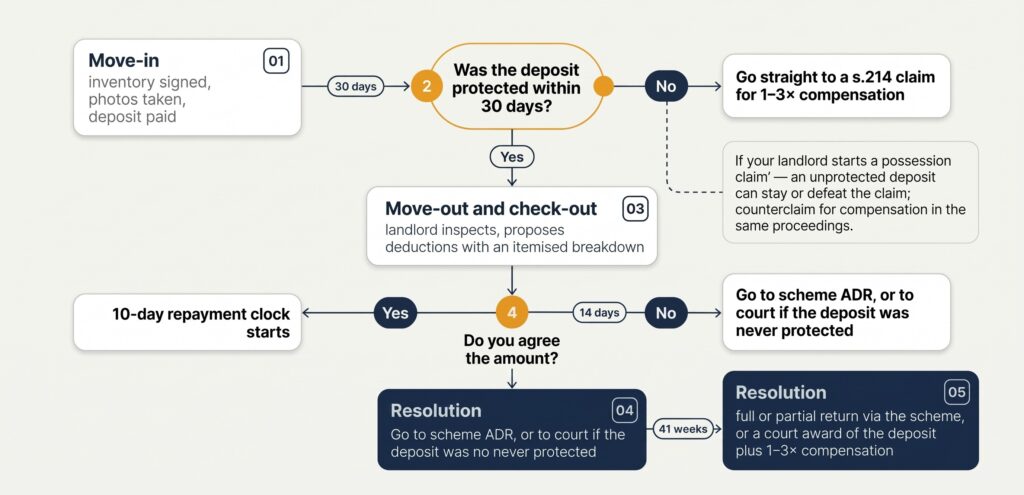
Every decision point from move-in to resolution.
If landlord not returning deposit, here is the Deposit Dispute Roadmap
Evidence

Build a Winning Evidence Pack

Tenants lose deposit disputes because their evidence is messy, not because they are wrong.

Move-in evidence

  • Signed inventory, dated and photographed
  • Timestamped photos of every room
  • An email confirming condition, “carpet already stained in bedroom”
  • Photos of gas, electricity and water meters

During tenancy evidence

  • Repair requests with dates and screenshots
  • Council or environmental health letters about damp or mould
  • Photos showing issues progressing over time
  • Entry logs if your landlord entered without 24 hours’ notice, see Landlord Entering Property Without Permission

Move-out evidence

  • Check-out report, signed if possible
  • Final meter readings with photos and dates
  • Cleaning receipts if you hired professionals
  • Proof you gave a forwarding address

Deposit-specific evidence

  • Bank statement showing the deposit payment, transaction highlighted
  • Scheme lookup screenshots, or a note that no record was found
  • Prescribed information, or a note of its absence
  • All email threads about deductions, exported as PDF

How to present it

One single PDF with bookmarked sections (01_Tenancy, 02_Inventory, 03_Deposit), a clear file-naming convention such as 01_Tenancy_Agreement.pdf, and a one-page cover sheet summarising dates, amounts and what you are claiming.

For more: How to Challenge Unfair Deposit Deductions

Reality Check

Small-Claims Reality: Timeline, Costs and the Hearing

Median time to trial for small claims is around 41 weeks based on April–June 2026 civil justice statistics, with a typical range of 6–12 months. Around 60–70% of cases settle before trial once the landlord sees a proper evidence pack.

Court fees recoverable if you win, verify current figures on GOV.UK
Up to £300
Issue fee £35
£25hearing fee
£300–£500
Issue fee £50
£25hearing fee
£500–£1,000
Issue fee £70
£25hearing fee
££1,000–£1,500
Issue fee £80
£25hearing fee
£1,500–£3,000
Issue fee £115
£25hearing fee
Total typical cost: £60–£140 including issue and hearing fees, recoverable if you win.

What happens at the hearing

  1. Check in. Arrive 15 minutes early, or log in 10 minutes early for a video hearing.
  2. The judge introduces the parties. Names and claim details are confirmed.
  3. The landlord presents first. They explain why they are keeping the deposit.
  4. You present. Walk through your evidence pack, cite the betterment rules, and highlight the s.213 breaches.
  5. The judge asks questions. Usually five to ten minutes in total.
  6. Judgment. Often given the same day, or within seven days by post.

What judges care about:

  • The dates. Did the landlord protect the deposit within 30 days and serve the prescribed information?
  • The documents. Inventory, photos, bank statements.
  • Your credibility. Calm, organised, factual.
  • Whether you attempted the scheme’s dispute resolution first.
Compensation

What Can You Realistically Claim?

Deposit back
100% of the deposit if it was unprotected or wrongfully withheld.
Compensation
1–3x the deposit under s.214. Courts must award at least 1x the multiple depends on how long the breach lasted, whether the landlord eventually protected or repaid, and any prejudice to you such as financial hardship.
Court fees
Recoverable if you win.
Indicative range
For a £1,500 deposit, total awards often fall between £3,000 and £6,000 (deposit plus 1–3x), plus fees.
Honest note: outcomes vary by judge and by facts. This is guidance, not legal advice. Consider a solicitor or our membership support for case-specific help.
Real Situations

Situations Renters Face, And What to Do

→"My landlord says I left the place dirty and is keeping the whole deposit"

If the property was left as clean as at check-in, cleaning deductions are invalid.

Ask for an itemised deduction list with photos and inventory comparisons, then dispute using our template.

→"They're charging new-for-old on a 10-year-old sofa I stained"

Your landlord can only claim the reduced value after age and wear, not a brand-new replacement.

Challenge betterment and cite the apportionment formula in your dispute letter.

→"I never received any paperwork about my deposit"

Check all three schemes online. If there is no record, the deposit is likely unprotected.

Start at Step 1 above, gather your tenancy agreement and deposit proof, then claim 1–3×.

→"My landlord is threatening eviction because I asked for my deposit back"

Section 21 is abolished. Possession needs Section 8 grounds and a court order, and retaliatory motive can be raised. Check our eviction notice page.

Do not leave on a notice alone.

→"They say I owe rent arrears and are deducting from the deposit"

Unpaid rent is a valid deduction, but the landlord must show a clear arrears calculation.

Request a written breakdown and compare it against your bank statements.

→"I moved out months ago and they still haven't paid anything"

Long delays strengthen your case for a higher compensation multiple.

Send a 14-day letter before action, then file a Form N208 claim.

Quick Answers

Frequently Asked Questions

What is the small-claims process for deposit disputes?
File a Part 8 claim using Form N208 in the county court, attach your evidence, and request the deposit back plus 1–3× compensation. The court will schedule a hearing, and most cases settle before trial.
Can my landlord charge me for professional cleaning?
Only if your tenancy agreement required professional cleaning and the property was left dirtier than at check-in. Otherwise, cleaning deductions are invalid.
What if my landlord is deducting rent arrears but I disagree with the amount?
Request an itemised breakdown with evidence. If you still disagree, use the scheme's free dispute resolution where the deposit was protected, or escalate via a letter before action and a court claim where it was not.
How do I check if my deposit was protected?
Use the online checkers at TDS, DPS and MyDeposits with your address and tenancy details. If no record appears, the deposit is likely unprotected.
Can I stop my landlord from evicting me if they didn't protect my deposit?
An unprotected deposit can block a possession claim until the landlord protects or repays it. Post-RRA this is a general compliance bar, but you still need to defend any Section 8 claim properly.
What evidence do I need for a deposit dispute?
Gather your tenancy agreement, deposit receipt or bank statement, inventory and check-in/check-out reports, photos, and all correspondence about deductions. If the deposit was unprotected, note the absence of prescribed information.
What are valid reasons for a landlord to deduct from my deposit?
Valid deductions include unpaid rent, damage beyond fair wear and tear, and missing items listed in the inventory. Deductions must reflect actual loss, not betterment.
How long does my landlord have to return my deposit in England?
Once you and the landlord both agree the amount to be returned, the landlord must repay within 10 days. This is the "10-day rule" under best-practice guidance and scheme rules.
What if my landlord never protected my deposit?
If the deposit was not placed in a government-approved scheme within 30 days, you can claim it back plus 1–3× compensation via the county court, using Form N208 under s.214 Housing Act 2004.
How much compensation can I claim for an unprotected deposit?
The court must order at least 1× the deposit, and can go up to 3× depending on severity and conduct. Factors include delay, prejudice to you, and whether the landlord later protected or repaid.

How We Help

Support for Tenants With a Landlord Not Returning Deposit

Renters Rights Act Services gives you the letters, evidence checklists and case support to recover a deposit your landlord is holding onto, without paying solicitor fees. If the deduction arrived alongside a notice to leave, start with our guide to checking whether an eviction notice is valid.

💰

Deposit Return Demand Letter

Formal demand for deposit return within 10 days. Cites TDS obligations and dispute escalation.
Members Only
Deposit
💰

Deposit Recovery: Step-by-Step Guide

From end of tenancy to full deposit return. Dispute process, TDS, and small claims court option.
Members Only
Deposit
🔍

Situation Review

Submit your details and documents. We map your issue, flag key dates, and outline your options.

Members Only

Review
📞

Call Support

Not sure where to start? We’ll listen to your situation and point you in the right direction.
Members Only
Support

Free Guides

Latest Articles & Guides

We are not a law firm. Renters Rights Act Services provide information and guidance based on current UK housing legislation.

How to Ask Your Landlord for Your Deposit Back

How to Ask Your Landlord for Your Deposit…

If you want to know how to ask your landlord for your deposit…

What Happens If Your Landlord Did Not Protect Your Deposit?

What Happens If Your Landlord Did Not Protect…

If your landlord never put your deposit into a government-approved scheme, that’s more…

How Long Does a Landlord Have to Return a Deposit in England?

How Long Does a Landlord Have to Return…

Your landlord has 10 days to return your deposit once you’ve both agreed…

Can a Landlord Legally Keep Your Deposit?

Can a Landlord Legally Keep Your Deposit?

Yes, a landlord can legally keep some or all of a tenancy deposit…

How to Challenge Unfair Deposit Deductions

How to Challenge Unfair Deposit Deductions

If your landlord wants to take money from your tenancy deposit for cleaning,…

Your deposit is your money. Your landlord has 10 days to return it.

Join today and get instant access to the Deposit Return Demand Letter, Evidence Guide, and Situation Review service.

Scroll to Top