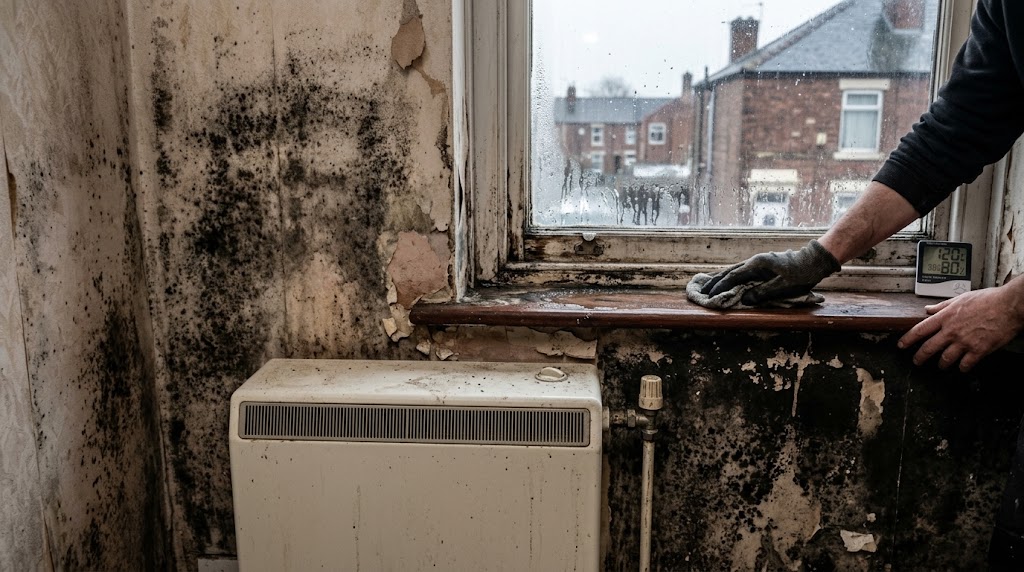
Persistent damp, black mould, a heating system that won’t hold temperature, or conditions that genuinely feel unsafe aren’t things you have to just live with. These are treated as hazards under UK housing law, with their own enforcement route through your council, separate from, and often faster than, an ordinary repair complaint.
Here’s what your rights actually are, and where the current law stands. For the wider picture on repair responsibilities generally, see our main guide on landlords not doing repairs and also see how Renters Rights Act Services helping tenant rights.
These Are Legal Hazards, Not Just “Repairs”
Damp, mould, and dangerous cold are assessed under the Housing Health and Safety Rating System (HHSRS), the same framework councils use to judge whether a property is safe to live in. Hazards are graded:
- Category 1 — serious hazards presenting a real risk to health or safety. Where a council identifies one, they have a legal duty to take action.
- Category 2 — less severe, but still requiring attention. Councils have the power to act, though not always the same automatic duty.
Persistent damp and mould, dangerous cold, and serious electrical or structural hazards are all things a Category 1 assessment can cover, depending on severity.
Is Mould Automatically the Landlord’s Fault?
Not automatically, but landlords can’t simply blame “tenant lifestyle” without investigating. Under both the HHSRS approach and the wider fitness-for-habitation standard, a landlord is expected to look into the actual cause, poor ventilation, cold bridging, or a building defect letting in water — rather than assuming condensation from cooking or drying clothes explains everything. If there’s an underlying building issue causing or worsening the mould, that’s squarely the landlord’s responsibility to fix, not yours to manage around.
Awaab’s Law: What It Actually Covers Right Now
This is a genuinely confusing area, so it’s worth being precise. Awaab’s Law, named after Awaab Ishak, introduced fixed legal timescales for landlords to investigate and fix serious hazards, but as of September 2026, it applies to social housing only in England:
- From 27 October 2025: social landlords must address emergency hazards and significant damp and mould hazards within fixed timeframes
- From November 2026: the rules extend to further hazards including excess cold, structural risk, and fire and electrical hazards, still within social housing
- From 2027: a further extension is planned to cover remaining HHSRS hazards, again within social housing
The Renters’ Rights Act 2025 created the legal power to extend Awaab’s Law to private rented homes, but as of September 2026, no commencement date has been confirmed for the private sector, and the specific timescales are still subject to consultation. You may see claims online that private-sector Awaab’s Law rules started in October 2026, this appears to be a mix-up with Scotland, which has introduced its own separate regulations (the Investigation and Commencement of Repair (Scotland) Regulations 2026) covering both social and private tenants from October 2026. Those Scottish regulations don’t apply in England.
What Private Tenants Are Protected By Right Now
Even without Awaab’s Law yet applying to private rentals in England, you’re not unprotected:
- Section 11 of the Landlord and Tenant Act 1985 requires your landlord to keep the structure, exterior, and heating installations in repair
- The Homes (Fitness for Human Habitation) Act 2018 requires your home to be genuinely fit to live in throughout the tenancy, this is broad enough to cover serious damp and mould even where it doesn’t map neatly onto a specific Section 11 category, and you can sue directly on this Act
- The HHSRS enforcement route through your council remains fully available to private tenants right now, regardless of Awaab’s Law’s private-sector timeline
In practice, this means a private tenant facing serious damp, mould, or heating failure already has real legal routes, they’re just not on the same fixed-clock timetable social housing tenants now have.
What to Do About Damp, Mould, or Heating Failure
- Report it in writing immediately, describing the problem and when it started. Include photos or video, a dated walkthrough video is particularly useful for showing extent and location.
- Don’t accept a “lifestyle” explanation without pushback if you believe there’s an underlying building issue, ask your landlord to investigate the actual cause, not just treat the surface symptom.
- Give your landlord a reasonable window to act, proportionate to severity, a heating failure in winter warrants urgency; slower-developing damp allows a bit more time, though not indefinite delay.
- Contact your council’s environmental health team if there’s no adequate response, request an HHSRS inspection specifically. This is free.
- Keep a running log of symptoms, especially if damp or cold is affecting anyone’s health, this strengthens both an environmental health case and any later compensation claim.
When It’s a Genuine Emergency
A complete loss of heating in freezing weather should be treated as urgent from the first report. Or immediate dangers, including exposed wiring, structural instability, or a gas smell, must be urgent from the first report. If there is a gas smell, contact the gas emergency service on 0800 111 999 immediately. If you smell gas, contact the National Gas Emergency Service on 0800 111 999 immediately. Also report the issue to your landlord.
Frequently Asked Questions
Does Awaab’s Law apply to me if I’m a private tenant? Not yet, as of September 2026. It currently applies to social housing only in England. The government has the power to extend it to private tenancies under the Renters’ Rights Act 2025. No start date has been confirmed by the government yet. The government will announce the start date later.
Can my landlord blame mould on how I live? Not without investigating first. Landlords must determine the actual cause of mould and defects. They should not blame lifestyle without evidence. Evidence should guide conclusions about the cause.
What’s the difference between a Category 1 and Category 2 hazard? Category 1 hazards present a serious risk to health or safety. Councils have a legal duty to act when they find one. Category 2 hazards are less severe, and councils have discretion rather than an automatic duty to act.
Can I get compensation for living with damp or mould? Usually, if your health or belongings are affected, this will be a separate civil claim. It does not come directly from the council’s enforcement action delivering remedies. Get advice from Shelter or Citizens Advice on your specific situation before pursuing this.
This article covers the law in England as of September 2026. It’s general information, not legal advice for your specific situation. GOV.UK’s tenant guide to the HHSRS can help you check your position. Shelter’s advice line can assist, especially since this area of law has recently changed. Last reviewed: September 2026.
What to Read Next
- What to Do If Your Landlord Ignores Repair Requests — the full escalation process, including environmental health and compensation
- What Repairs Is a Landlord Legally Responsible For? — the broader legal picture
- Your Landlord Is Not Doing Repairs: Full Guide — the complete cluster